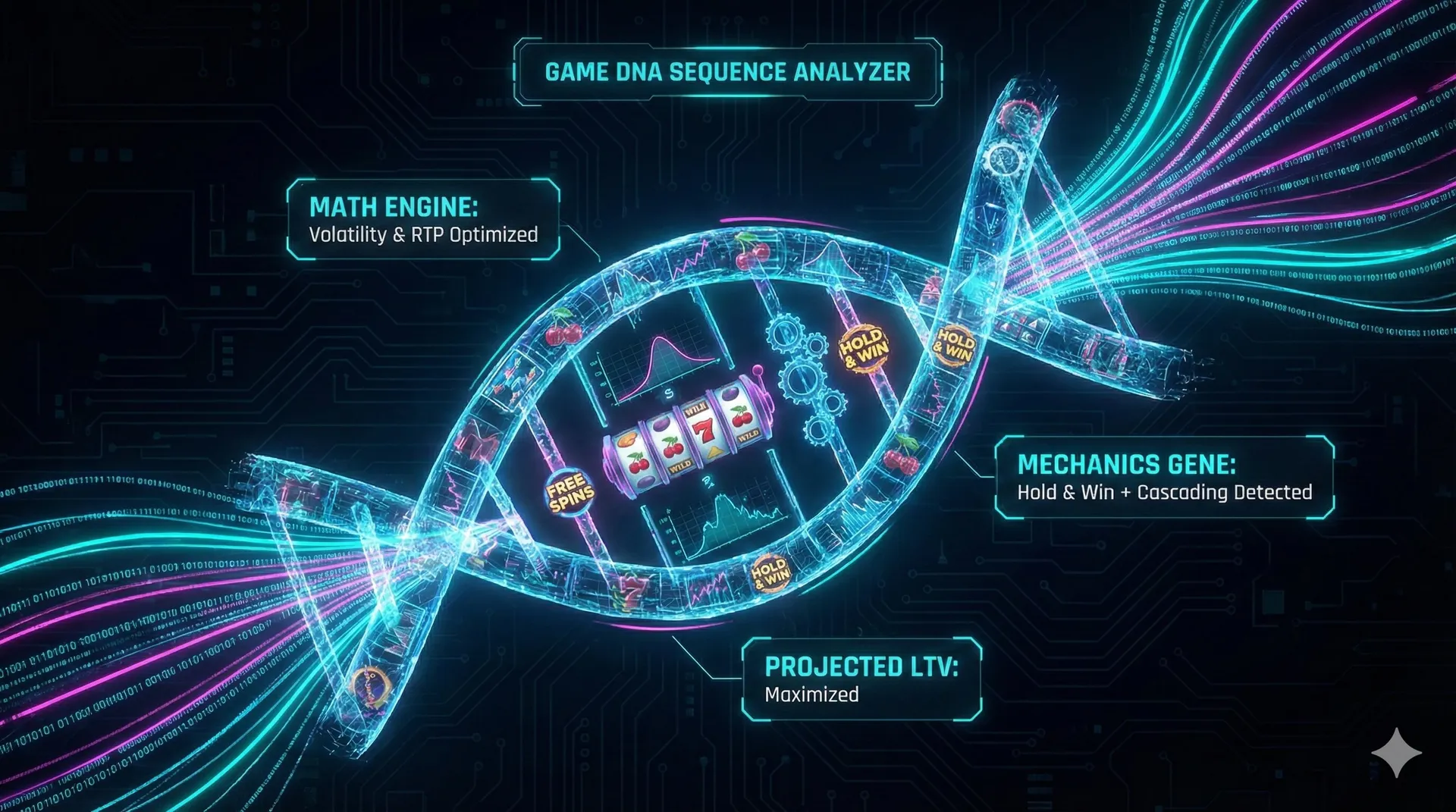
We are operating in an era where thousands of slot games hit the casino lobbies every year, but only a fraction secure long-term player retention. The difference between a fleeting novelty and a blockbuster hit is no longer just "gut feeling" or a catchy art style. It’s about understanding the game’s core molecular structure—its "Game DNA."
The End of Intuition-Only Game Design
For decades, iGaming development was largely driven by intuition. A studio would pick a popular theme (like Ancient Egypt or Classic Fruit), pair it with a standard math model, and hope the visual flair would be enough to attract operators and players alike.
Today, the market is too saturated and the cost of development too high to rely solely on guesswork. Top-tier studios and operators are turning to deep data analytics to reverse-engineer what makes a game successful before a single line of code is written or a single 3D asset is rendered. This shift has given rise to the concept of Game DNA.
What Exactly is "Game DNA"?
Just as human DNA contains the genetic instructions for life, a slot's "Game DNA" is the unique combination of mathematical, mechanical, and visual attributes that dictate how a game behaves and who it appeals to.
Game DNA can be broken down into several foundational sequences:
- The Math Engine (Volatility & RTP): This is the heartbeat of the game. Does the math model drip-feed small wins to extend playtime (low volatility), or does it starve the player before delivering a massive, adrenaline-pumping payout (high volatility)?
- Core Mechanics & Features: Are players chasing Free Spins, hold-and-win respins, cascading reels, or expanding wilds? The mechanic dictates the player's primary goal during the session.
- The Pacing and Hit Frequency: How often does the player feel they are "winning" or experiencing a near-miss? This directly impacts emotional engagement and retention.
- The Meta-Theme and Art Style: Is the game an ultra-realistic 3D cinematic experience, or a high-fidelity 2D hybrid? How does the theme interact with the mechanics? (e.g., cascading gems vs. a heavy, mechanical wheel spin).
When these components are perfectly aligned, the Game DNA is optimized for maximum player lifetime value (LTV).
How Data is Changing the Studio Roadmap
By analyzing the Game DNA of top-performing titles across the market, studios are now using data to make strategic production decisions.
1. De-risking Development
Developing a modern slot—especially those featuring Cinematic CGI or complex hybrid mechanics—is an expensive endeavor. By analyzing prevailing market share shifts, studios can identify mechanic combinations that are actively growing in popularity and avoid saturated sub-genres. If the data shows player fatigue with standard "Book of..." mechanics, studios can pivot their GDD (Game Design Document) early in the pipeline.
2. Reverse-Engineering Success
Why did a competitor's fishing-themed slot dominate the lobby for six months? By breaking down its Game DNA, data platforms like Slotifai allow producers to see beneath the art layer. Perhaps it wasn't the fishing theme at all, but a specific combination of medium volatility, a unique multi-stage collection feature, and a 25% hit frequency that drove the engagement. Studios can isolate these successful "genes" and graft them onto entirely new themes and narratives.
3. Identifying Portfolio Gaps for Operators
It isn't just studios leveraging Game DNA; casino operators and CRM managers are using it to optimize their lobbies. If an operator's dashboard reveals that their highest LTV players predominantly engage with high-volatility, grid-style cascading slots, the operator knows exactly what Game DNA to look for when signing new content agreements or running targeted promotions.
Entering the Era of the Portable Slot Processor
The days of manually reviewing PDF Game Design Documents and guessing how a game might perform are over. The industry standard is shifting toward automated intelligence.
Tools like Slotifai’s Portable Slot Processor and Game DNA Dashboards are allowing decision-makers to upload parameters, instantly compare games at a microscopic level, and visualize market share shifts in real-time. By turning qualitative design concepts into quantitative datasets, studios can clearly see the "evolutionary tree" of mechanics and themes.
The Bottom Line
Creativity and art will always be the soul of slot game design, but data is now the skeleton that supports it. Understanding Game DNA doesn't restrict creativity—it focuses it. It gives artists and mathematicians a proven framework to build upon, ensuring that when the game finally hits the lobby, it has the genetic makeup of a hit.
Ready to stop guessing and start analyzing?
Use Slotifai's Game DNA features to dissect the mechanics, art styles, and math models of the industry's top-performing games to build your next blockbuster.