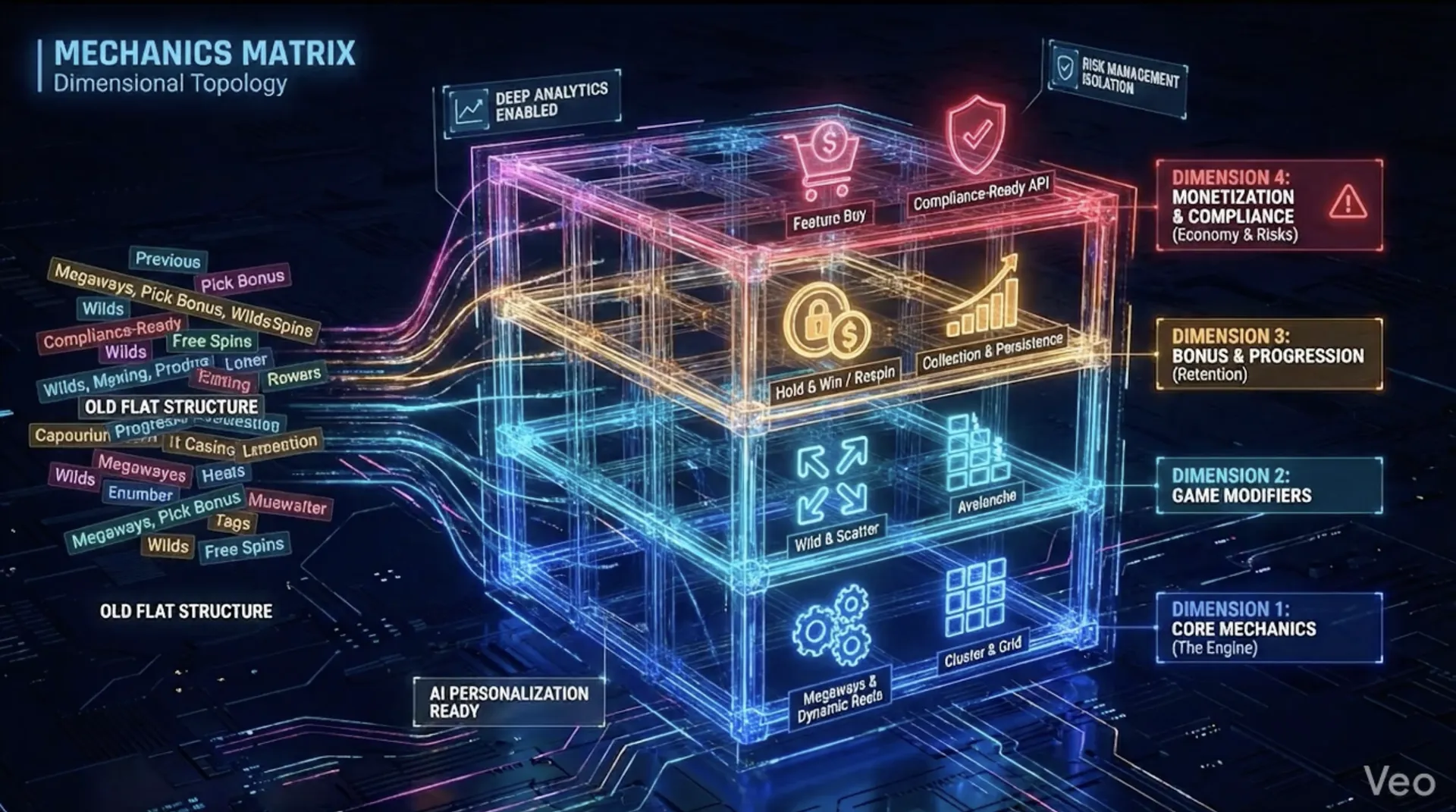
In the iGaming industry, where new slots are released by the hundreds every month, standard lists of game features are becoming a relic of the past. For a modern B2B aggregator or analytics platform, storing features simply "comma-separated" is a surefire way to lose clients. The professional market demands a shift to Dimensional Topology.
The Crisis of "Flat" Lists
Most affiliate sites and basic directories use a flat structure: they place the game engine (e.g., Megaways) and the marketing name for a bonus game (e.g., Pick Bonus) on the same level. For the B2B segment, this creates chaos in analytics and critical compliance risks.
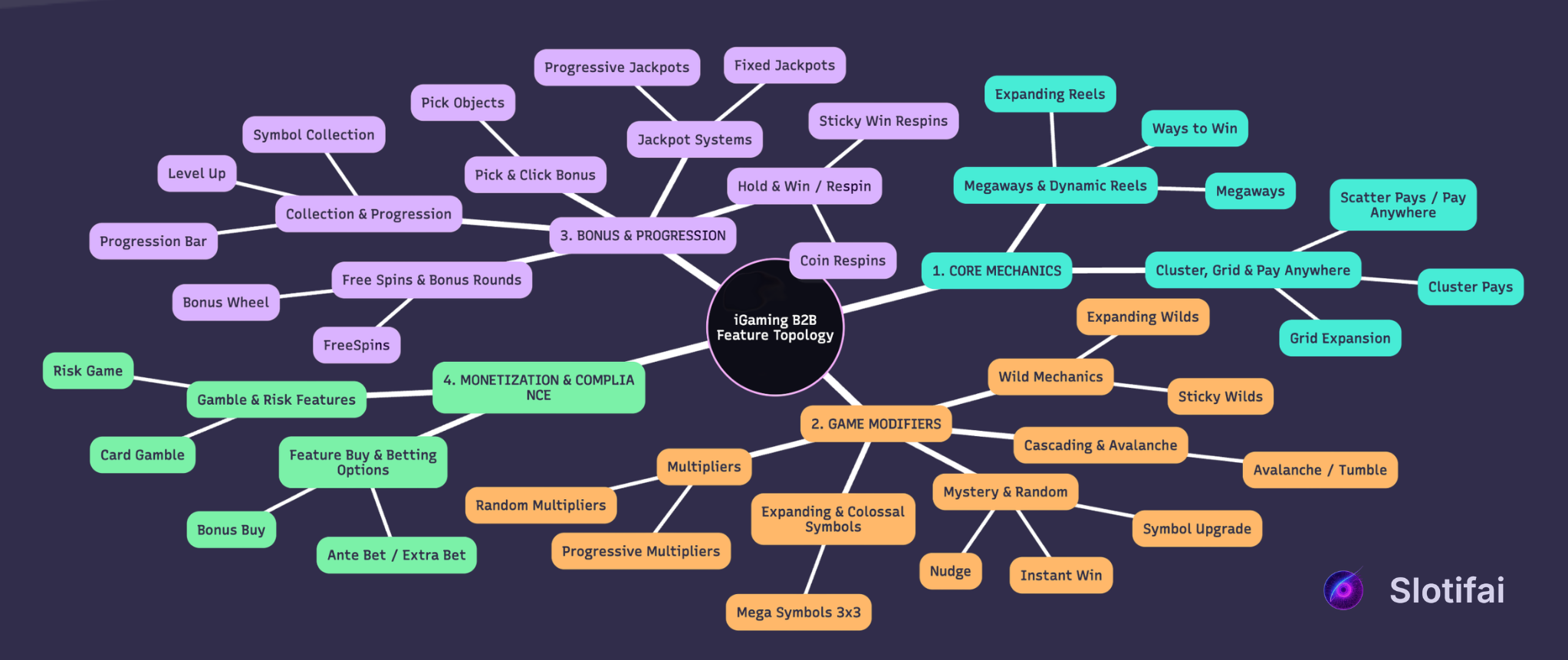
Dimensional topology solves this problem by separating the chaotic data array into four strategic dimensions.
Dimension 1: Core Mechanics (The Game Engine)
This is the foundation defining the slot's mathematical DNA. This is "how" wins are formed at the base level. In a professional topology, we distinguish:
- Cluster & Grid Mechanics: Slots without paylines, where wins are formed in clusters or via the Pay Anywhere mechanic.
- Megaways & Dynamic Reels: Games with a variable number of symbols on the reels.
- Ways to Win: Fixed mathematical models (243, 1024 ways).
Separating engines allows operators to analyze audience preferences: for example, Gen Z is more likely to choose Grid slots, while experienced players remain loyal to classic lines.
Dimension 2: Game Modifiers
These are tools that work within the base game, changing its dynamics without transitioning into a bonus round.
- Wild & Scatter Mechanics: All variations of substitute symbols (Sticky, Expanding, Walking).
- Multipliers: A key marker of the game's "streamer potential."
- Cascading & Avalanche: The mechanic for processing wins.
Dimension 3: Bonus & Progression (Retention)
The most crucial dimension for VIP managers and CRM departments. Here we separate short-term bonuses from long-term retention mechanics.
- Free Spins & Bonus Rounds: Classic game interruptions.
- Hold & Win / Respin: The most popular mechanic of recent years, based on cyclical respins.
- Collection & Persistence: Accumulation mechanics (progress bars, levels). This is the "gold standard" of retention, where the player returns to the game to complete an initiated cycle.
Dimension 4: Monetization & Compliance (Economy and Risks)
This dimension is critical for B2B operations in regulated markets.
- Feature Buy & Betting Options: All options for buying bonuses (Bonus Buy) and extra bets (Ante Bet).
- Gamble & Risk Features: Options for doubling the win.
Isolating this dimension allows the operator to click once to disable all games with Bonus Buy for markets where it is legally prohibited (e.g., the UK or the Netherlands), avoiding massive fines.
Why is this beneficial for B2B?
- Compliance-ready API: The ability to filter games based on regulatory restrictions at the code level.
- Deep analytics: An operator can understand whether a Megaways engine generates more revenue paired with Hold & Win or with classic Free Spins.
- Personalized delivery: AI models work significantly more accurately when they analyze concrete mathematical dimensions rather than random tags.
Conclusion:
Dimensional topology transforms a database into an intellectual asset. In a world where every provider tries to invent a new name for an old mechanic, the ability of a B2B platform to see the true structure of the game is its main competitive advantage.