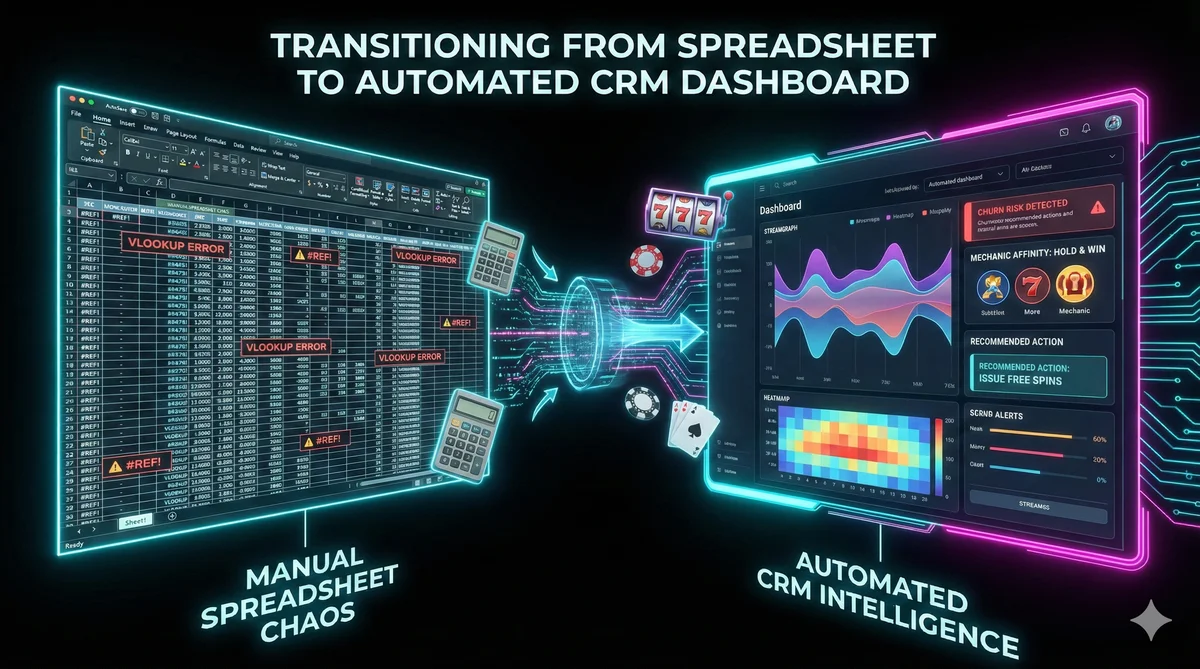
In an industry moving at lightspeed, relying on monolithic, manually updated spreadsheets to manage player relationships and game lifecycles is a critical operational bottleneck. By the time the data is gathered, cleaned, and analyzed, the actionable window has often closed. It’s time to modernize: here is the definitive guide to moving from Excel isolation to an Automated CRM Dashboard.
The Problem with the "Spreadsheet Casino"
Walk into the back offices of many mid-tier casino operators today, and you will find highly skilled CRM managers spending 70% of their day wrangling CSV exports from disparate game providers, payment gateways, and platform suppliers. They are manually cross-referencing Player X's deposit history with Game Y's RTP performance.
The "Spreadsheet Approach" suffers from three fatal flaws in 2026:
- Latency of Insight: Analyzing cohorts manually takes days. If a new game release causes an unexpected spike in VIP churn due to heavily skewed volatility, a manager relying on a weekly pull won't see the damage until it’s already done.
- Human Error: VLOOKUPs break. Formatting errors occur during data ingestion. A single misaligned column can result in a promotional campaign targeting the wrong segment, wasting bonus budgets.
- Siloed Intelligence: Spreadsheets rarely communicate with each other. The game performance spreadsheet doesn't talk intuitively with the player demographic spreadsheet. The connection is entirely reliant on the human operator.
Defining the Automated CRM Dashboard
An automated CRM (Customer Relationship Management) Dashboard is a centralized intelligence hub. It automatically ingests raw data continuously via APIs from your platform layer and processes it through predefined analytical models.
Instead of logging in to find a wall of raw numbers, a manager logs in to find actionable alerts: "Player Segment C (High Value / Low Frequency) has dropped engagement on Megaways mechanics by 15% this week. Recommended Action: Issue 20 Free Spins on the new low-volatility Asian-themed release."
Step 1: The Data Audit & API Integration
The transition starts with a brutal audit of your current data sources. You must identify exactly where the data lives and how it can be extracted. The goal is to establish seamless API connections that feed into a central data warehouse.
- Game Performance APIs: Real-time spin data, GGR (Gross Gaming Revenue), NGR (Net Gaming Revenue), and RTP fluctuations.
- Player Account Data: Registration dates, total deposits, withdrawal frequencies, and session lengths.
- Game Meta-Data (The DNA): This is where Slotifai excels. Your dashboard must understand what the games are. Does the game feature cascading reels? Is it high volatility? What is the core art style? Having player data is useless without the contextual Game DNA data to match it against.
Step 2: Defining Automated Triggers and Cohorts
Once the data is flowing, the next step is defining the rules of the engine. Automation means the system works while you sleep. You need to establish dynamic player cohorts based on their behavior, not static demographic buckets.
Examples of automated triggers include:
- The "Churn Risk" Trigger: If a player’s average session length drops by 30% over three consecutive sessions, the CRM dashboard automatically tags them as a churn risk and flags them for a targeted retention promotion.
- The "Mechanic Affinity" Cohort: The dashboard automatically groups players who spend more than 50% of their wallet on "Hold & Win" mechanics. When a new Hold & Win game drops, this cohort receives a bespoke push notification.
Step 3: Visualizing the Intelligence
The final layer is the UI. A well-designed CRM Dashboard should utilize streamgraphs, heatmaps, and lifecycle curves. At a glance, an executive should be able to see the health of specific game themes across different player segments.
This is precisely why we built the Slotifai CRM Dashboard integration. We bridge the gap between abstract game data and concrete player behavior, providing predictive insights on cross-selling opportunities and lobby optimization without requiring a PhD in data science.
The ROI of Automation
Transitioning from spreadsheets to an automated system is not a minor IT project; it's a fundamental shift in business operations. However, the ROI is typically realized within the first quarter. Automated dashboards reduce bonus spend waste, increase the precision of targeted marketing, and free up your most talented analysts to focus on high-level strategy rather than low-level data entry.
Ready to ditch the spreadsheets?
Discover how the Slotifai CRM Dashboard natively integrates Game DNA analysis with your operational data to revolutionize your player retention strategy.