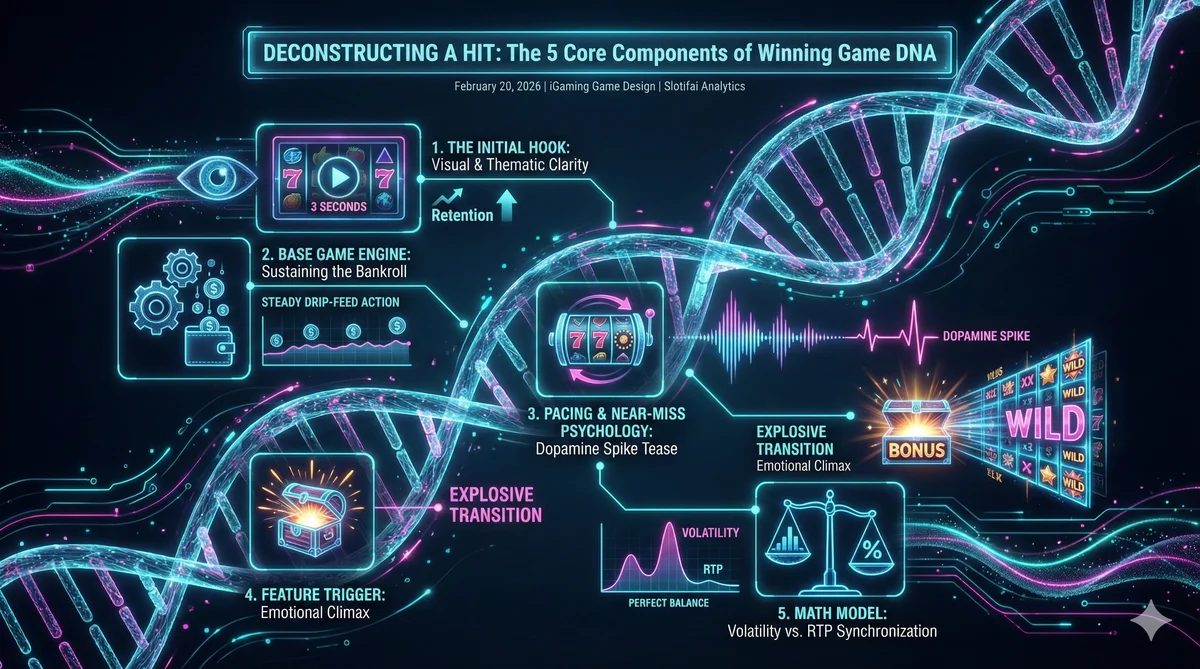
The iGaming industry produces thousands of forgettable slots every year, yet a small handful of games achieve legendary status, dominating lobby positions for years. The secret to their longevity isn't magic; it's a perfectly balanced genetic code. Let’s deconstruct the 5 core components of a winning Game DNA.
1. The Initial Hook: Visual and Thematic Clarity
A player judges a game in the first three seconds. If the thumbnail and opening load screen do not instantly communicate the game’s core proposition, the bounce rate skyrockets. The visual DNA must align with player expectations. If a game features a dark, grimy Cyberpunk theme, players subconsciously expect high volatility and complex mechanics. If they receive a low-volatility, fruit-style payout structure, the dissonance will cause them to churn.
2. The Base Game Engine: Sustaining the Bankroll
While massive multipliers in free spins generate the marketing headlines, the base game engine is what determines player LTV. The Game DNA of a hit requires a base game that provides a steady drip-feed of minor action—small wins, cascading drops, or collection meters. This isn’t about winning big; it’s about providing enough entertainment value and bankroll sustainment to drag the player toward the bonus features.
3. The Pacing and "Near-Miss" Psychology
This is the most critical and often overlooked element. How does the game feel? A hit game artificially manipulates pacing. When two scatter symbols land, does the third reel dramatically slow down? Does the audio swell? This "tease" creates a powerful dopamine spike, regardless of whether the third scatter actually lands. Masterful games deploy these near-miss events with mathematical precision to maximize emotional engagement.
4. The Feature Trigger: The Emotional Climax
When the bonus round finally triggers, the mechanical DNA must shift gears completely. If the base game is a slow grind, the feature must be explosive. Whether it consists of expanding wilds, sticky multipliers, or multi-level collection mechanics, the feature is the reason the player is spinning. The transition must feel rewarding, and the potential for a massive payout must be clearly telegraphed to the player through UI and audio.
5. The Math Model: Volatility vs. RTP Synchronization
The skeleton that holds all these components together is the Math Model. A successful game perfectly synchronizes its volatility with its Return to Player (RTP). A highly volatile Megaways-style DNA must reserve a massive percentage of its RTP budget for the rare, astronomical wins. Conversely, a casual, grid-based puzzle slot must spread its RTP evenly to ensure the player feels constantly rewarded. A mismatch in this DNA sequence guarantees a failed launch.
Conclusion: Engineering the Future
Using platforms like Slotifai, studios can now analyze the DNA structures of the most successful games in the market, identifying the precise combination of volatility, pacing, and mechanics that drive player retention, ensuring their next release has the genetic makeup of a hit.