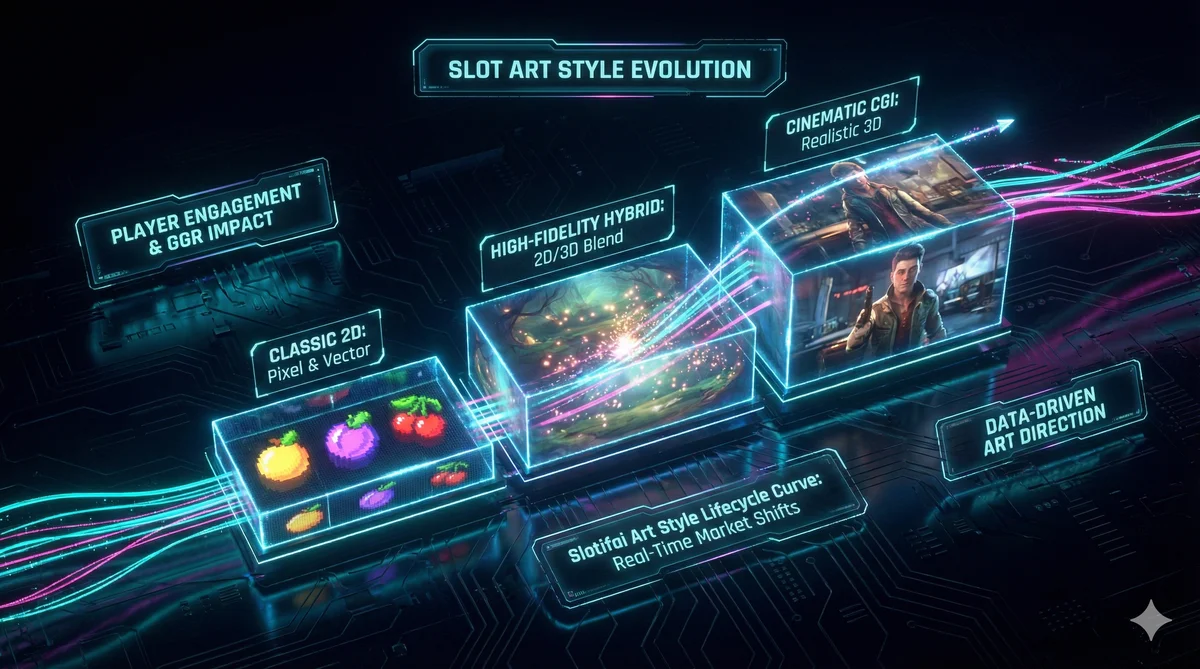
The visual language of slot games has evolved from a functional necessity into a primary driver of player engagement. As we navigate through 2026, the spectrum of slot art styles is wider than ever before. We trace the history from flat 2D art to immersive Cinematic CGI, exploring its direct financial impact on player retention and acquisition costs.
The Foundational Era: 2D Vector & Pixel Art
Twenty years ago, slot games relied heavily on rudimentary 2D vector art or pre-rendered images. These designs were functional, lightweight, and perfectly suited for early desktop and mobile devices. Games like the original fruit slots or standard card-symbol games established the baseline visual vocabulary of iGaming.
While basic 2D art may seem dated today, it still holds a massive nostalgic appeal for a specific demographic of player. However, pure retro pixel-art or simplistic 2D games often struggle to attract the next generation of players who are accustomed to high-fidelity console gaming. To survive in the modern lobby, simple 2D games must compensate with exceptionally volatile math models and ultra-fast pacing to drive engagement.
The Middle Ground: High-Fidelity Hybrids
As device capabilities increased, so did the ambition of game studios. We entered the era of the High-Fidelity Hybrid. This art style blends stunning, hand-painted 2D backgrounds and symbols with subtle 3D animations, particle effects, and dynamic lighting.
This approach has become the industry standard for several reasons:
- Optimal Performance: It looks premium without demanding the excessive processing power required for full 3D rendering, ensuring it runs smoothly on mid-tier mobile devices in emerging markets.
- Creative Flexibility: Artists can create lush, vibrant worlds—from deeply atmospheric Aztec jungles to bright, neon-lit retroscapes—while maintaining crisp symbol clarity on smaller screens.
- Cost-Effective: It provides a AAA look without the astronomical budget needed for full cinematic production.
According to the Slotifai platform data, High-Fidelity Hybrid games currently account for the largest proportion of total gross gaming revenue (GGR) across top-tier operators.
The New Frontier: Cinematic CGI & Realistic 3D
The arms race for visual dominance has led us to Cinematic CGI. In 2026, we are seeing slots that feature fully rendered 3D environments, complex character rigs, motion-captured animations, and cinematic cutscenes that trigger upon entering bonus rounds.
This is not merely window dressing; it fundamentally changes the player experience:
- Narrative Immersion: Cinematic CGI allows for complex storytelling. Players are not just spinning reels; they are participating in a narrative arc. The 3D protagonist standing beside the reels reacts to near-misses and big wins, creating a parasocial bond that extends session lengths.
- Perceived Value: A game that looks like a high-budget video game commands an immediate perception of premium quality, naturally drawing in high-LTV players and streamers who value visual spectacle for their audiences.
- The Cost of Entry: Developing a Cinematic CGI slot requires specialized 3D artists, animators, and significantly longer development cycles. This high barrier to entry protects against cheap clones, allowing the game to hold its premium lobby position longer.
The Data-Driven Approach to Art
Choosing an art style is no longer a purely creative decision; it’s a financial one. If a studio is building a high-volatility, Megaways-style game aimed at hardcore gamblers, investing heavily in narrative Cinematic CGI might be wasted, as these players tend to prioritize spin-speed and math clarity over visual distraction.
Conversely, if building a casual, low-volatility game designed to attract new players, high-fidelity visuals are mandatory to capture and hold their attention during the learning curve.
Predicting the Next Shift
With tools like Slotifai’s Art Style Lifecycle Curve, studios and operators can track the trajectory of visual trends in real-time. By analyzing market share shifts across thousands of titles, we can predict exactly when the market reaches saturation point for a specific aesthetic (e.g., hyper-realistic horror) and when it's time to pivot back to a cleaner, stylized approach.
The studios that dominate the next decade will be the ones who stop relying on artistic intuition and start engineering their visuals based on hard data.